Bull Breeding Soundness Evaluation: The $50 Test That Saves Cattle Producers Thousands
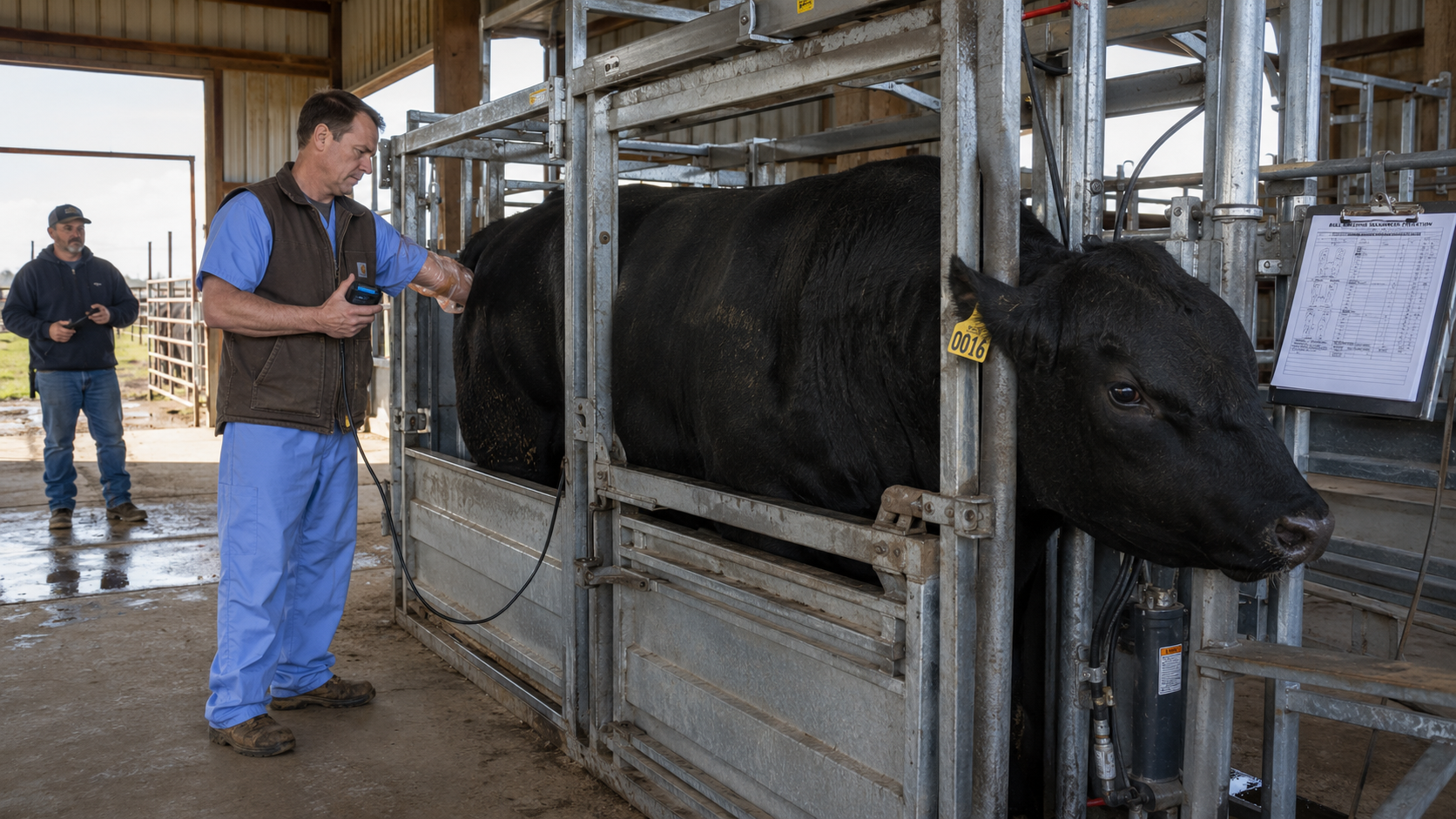
Bull Breeding Soundness Evaluation: The $50 Test That Saves Cattle Producers Thousands
A rancher in Nebraska turned his yearling bulls out with 80 cows in June 2025. He had purchased five bulls from a reputable breeder that spring, paying $3,500 per head. The bulls looked excellent. Strong frames. Good disposition. Solid genetics. He felt confident about his breeding season. When he pregnancy checked in November, 23 cows came up open. At $1,210 in lost revenue per missed conception, those open cows cost him $27,830. One of his five bulls was subfertile. He never knew until the damage was done.
A breeding soundness evaluation conducted 60 days before turnout would have identified that subfertile bull for $50. The test takes 30 minutes. The information is definitive. A bull either passes or fails. There is no ambiguity. Yet data suggests that fewer than 30 percent of bulls used in natural service receive a breeding soundness evaluation before the breeding season begins.
This article explains what breeding soundness evaluation involves, why one in ten bulls fails the exam, when to test, and how this simple veterinary procedure protects your investment and ensures breeding season success. The numbers are clear. The return on investment is overwhelming. The only question is why more producers are not using this tool.
What One Subfertile Bull Actually Costs Your Operation
Oxford Academic published research in 2025 examining the economic impact of subfertile bulls in commercial cow-calf operations. The findings quantify what producers have long suspected but rarely calculated precisely.
A bull with compromised fertility in a single-sire breeding group reduces conception rates by an average of 30 to 50 percent compared to a fully fertile bull. In a group of 30 cows exposed to a subfertile bull for a 60-day breeding season, that translates to 9 to 15 cows failing to conceive during the first cycle. Some of those cows will conceive later in the breeding season. Some will remain open.
Each cow that conceives one cycle late produces a calf that is 21 days younger at weaning. At 2.5 pounds per day gain, that calf weighs 52 pounds less at weaning. At $440 per hundredweight for 550 pound steers in spring 2026, that 52 pound difference costs $229 per head. If 10 cows conceive one cycle late due to a subfertile bull, the loss is $2,290 in reduced weaning weights alone.
Cows that fail to conceive at all represent complete loss of that year's calf crop. At current 2026 calf values, a 550 pound steer is worth $2,420. A cow that remains open generates zero calf revenue and consumes a full year of feed, pasture, and management costs estimated at $1,200 annually for moderate input operations. The combined loss per open cow is $3,620 when accounting for lost calf value and ongoing cow costs.
The Oxford research calculated that a subfertile bull in a typical commercial operation with 30 cow exposure costs an average of $9,600 in lost revenue and delayed calving over a single breeding season. That figure accounts for reduced conception rates, delayed breeding, lighter weaning weights, and complete reproductive failure in a percentage of the exposed cows.
Some producers run multi-sire breeding groups where several bulls share a larger cow herd. This dilutes the impact of a single subfertile bull because fertile bulls in the group breed cows that the subfertile bull fails to settle. But multi-sire groups create their own problems. Dominant bulls may limit breeding access for subordinate bulls regardless of fertility status. Determining which bull bred which cow becomes impossible without DNA testing. And if two of your three bulls are subfertile, the third bull cannot physically compensate for that deficit across 90 or 120 cows.
The financial impact extends beyond a single season. Cows that conceive late in year one calve late in year two, perpetuating the problem. Those late-born calves enter the replacement heifer pool at a disadvantage, being younger and lighter than early-born contemporaries. Culling decisions become more difficult when a significant percentage of your calf crop is uniformly late due to bull fertility issues rather than individual cow problems.
Producers in the United Kingdom and Australia face identical economic impacts when subfertile bulls compromise breeding season success. A delayed or failed conception costs the same relative to local market prices whether that cow is in Montana, Queensland, or the Scottish Highlands. The biology is universal. The financial consequences are proportional to local calf values and input costs.
What Breeding Soundness Evaluation Actually Measures
A breeding soundness evaluation is a systematic veterinary examination that assesses a bull's physical and reproductive capacity. The exam follows standardized protocols established by the Society for Theriogenology, ensuring consistency across veterinary practices and geographic regions.
The physical examination evaluates overall health, structural soundness, and reproductive anatomy. Your veterinarian checks body condition, confirms the bull is free of illness or injury, and examines legs and feet for structural problems that would limit the bull's ability to travel, mount, and breed cows effectively. A bull with chronic lameness or foot rot may be physiologically fertile but physically unable to perform natural service.
The reproductive anatomy examination is systematic and thorough. Your veterinarian palpates both testicles to assess size, shape, tone, and symmetry. Scrotal circumference is measured using a specialized tape called a scrotal tape. This measurement correlates directly with sperm production capacity. Minimum scrotal circumference thresholds vary by age and breed, but a mature beef bull typically requires 34 to 36 centimeters minimum circumference to pass. Yearling bulls have lower thresholds adjusted for age and development.
The veterinarian examines the entire scrotum and spermatic cord for abnormalities including testicular hypoplasia, cryptorchidism, hernias, varicocele, or injury. The epididymis is palpated to ensure normal size and consistency. Abnormalities in these structures indicate compromised fertility.
Internal reproductive structures are examined via rectal palpation. Your veterinarian assesses the seminal vesicles, ampullae, and accessory glands. Abnormal size, asymmetry, or abnormal texture in these structures suggests infection or dysfunction that compromises semen quality.
The most critical component of breeding soundness evaluation is semen collection and analysis. Your veterinarian collects a semen sample using an electroejaculator. This device delivers mild electrical stimulation that induces ejaculation. The process is brief and does not harm the bull. The collected semen is immediately evaluated under a microscope.
Semen evaluation measures four primary factors. Sperm motility is the percentage of sperm cells moving progressively forward. A passing bull requires minimum 30 percent progressive motility. Lower motility means fewer viable sperm reach the egg for fertilization. Sperm morphology examines the physical structure of individual sperm cells under high magnification. Normal sperm have a properly formed head, midpiece, and tail. Abnormal morphology includes defects like detached heads, bent tails, proximal droplets, or deformed heads. Bulls must have at least 70 percent morphologically normal sperm to pass.
Sperm concentration measures the density of sperm cells per milliliter of semen. Combined with ejaculate volume, this determines total sperm output. Bulls with low concentration may have adequate motility and morphology but insufficient total sperm numbers to settle multiple cows during a breeding season.
A bull receives a pass or fail classification based on these combined factors. Some veterinarians use a three-tier system: satisfactory, questionable, or unsatisfactory. A questionable classification indicates the bull is marginal and should be retested in 30 to 60 days or used with reduced cow exposure. An unsatisfactory classification means the bull should not be used for natural service.
The entire examination takes 20 to 40 minutes per bull depending on the veterinarian's experience and the bull's cooperation. Cost ranges from $25 to $75 per bull with most operations paying $40 to $50. Mobile veterinarians often offer discounted rates for examining multiple bulls during a single farm visit, reducing per-head costs when testing an entire bull battery at once.
Why One In Ten Bulls Fails
Industry data compiled from thousands of breeding soundness evaluations across the United States shows that approximately 10 to 15 percent of bulls fail the examination. The percentage is higher in yearling bulls and lower in mature bulls that have previously passed evaluation, but the overall failure rate remains consistent at roughly one in ten when all age groups are combined.
Several factors contribute to bull fertility problems. Congenital defects including testicular hypoplasia or abnormal reproductive tract development prevent some bulls from ever achieving satisfactory fertility. These defects are often genetic and may not be visually apparent until breeding soundness evaluation reveals the problem. Breeders selling bulls should conduct breeding soundness evaluation before sale to identify these animals, but not all seedstock operations follow this practice consistently.
Injury to the testicles or scrotum from trauma, frostbite, or infection causes temporary or permanent fertility loss. A bull kicked by a cow, injured in a fence, or experiencing frostbite during extreme cold can develop compromised fertility that persists for months. The testicles are particularly vulnerable to temperature fluctuation. Elevated testicular temperature from fever, prolonged hot weather, or thick scrotal insulation during summer can damage sperm production for 60 to 90 days following the thermal insult.
Nutritional deficiency particularly in trace minerals like zinc, selenium, and vitamin E affects sperm production and quality. Bulls on marginal nutrition during growth and development may reach adequate body size but fail to develop full reproductive capacity. Over-conditioning is equally problematic. Extremely fat bulls often have reduced libido, compromised mobility, and lower fertility compared to bulls in moderate body condition.
Venereal disease including trichomoniasis and campylobacteriosis causes infertility in bulls. These diseases are typically acquired through breeding infected cows and can persist in the bull's reproductive tract indefinitely. Bulls infected with trichomoniasis may test fertile on breeding soundness evaluation because the parasite does not always affect semen quality, but they transmit the disease to cows during breeding, causing early embryonic death and reproductive failure. Separate testing is required to detect trichomoniasis and campylobacteriosis.
Age affects bull fertility in both young and old animals. Yearling bulls are still developing reproductive capacity and have higher failure rates than mature bulls. Very old bulls may experience declining fertility as testicular function decreases with age. Most bulls reach peak fertility between three and eight years of age.
The reality that one in ten bulls fails breeding soundness evaluation means that any producer running bulls without testing is gambling on fertility. A producer purchasing three yearling bulls without testing has a 27 percent probability that at least one of those bulls is subfertile. Running five bulls without testing gives you a 41 percent chance that at least one is compromised. These are not acceptable odds when a $50 test eliminates the uncertainty.
When To Test Bulls For Optimal Results
Timing of breeding soundness evaluation matters because fertility can change and test results reflect the bull's status at the moment of examination, not his status 90 days later.
The optimal time to conduct breeding soundness evaluation is 30 to 60 days before the planned breeding season start date. This window provides enough time to identify problems, make replacement decisions, and retest questionable bulls while not testing so far in advance that fertility status might change before actual breeding begins.
A bull tested in February for a June breeding season has four months for things to change. Injury, illness, or nutrition problems occurring after February testing may compromise fertility by June. A bull tested in May for a June breeding season leaves minimal time to source replacement bulls if a problem is discovered. The 30 to 60 day window balances these competing concerns.
Bulls should be tested annually regardless of past results. Fertility is not permanent. A bull that passed evaluation last year may fail this year due to injury, age, or disease acquired since the previous test. Producers who test bulls once and assume the results are valid indefinitely are taking unnecessary risk.
Newly purchased bulls require testing before introduction to your cowherd regardless of whether the seller claims the bull was tested. Seller claims of fertility are not verifiable unless you receive written documentation of the breeding soundness examination signed by the examining veterinarian. Even with documentation, bulls can be injured or become ill during transport and handling. Testing purchased bulls before breeding protects your investment.
Yearling bulls present a special case. Bulls can be tested as early as 12 months of age, but scrotal circumference and semen production capacity are still developing. A yearling bull that fails evaluation at 12 or 14 months may pass at 16 or 18 months. If you purchase yearling bulls in early spring for late spring or summer breeding, test them 30 days before turnout to confirm they have matured sufficiently. If a yearling bull fails, reduce his cow exposure from 25 to 30 cows down to 10 to 15 cows to account for his reduced breeding capacity, or replace him entirely if your operation cannot accommodate the risk.
Bulls used in artificial insemination programs require testing before semen collection regardless of timing. AI studs conduct their own extensive fertility testing, but bulls standing for private treaty collection or on-farm AI use should be evaluated to confirm suitability before investing in the collection and storage process.
Producers in regions with year-round or multiple breeding seasons should test bulls before each breeding season. A bull that breeds cows in spring and again in fall needs evaluation before both breeding periods because fertility can change across that time span.
Weather and environmental factors affect optimal testing timing. Testing bulls during or immediately after periods of extreme heat or cold may yield artificially poor results due to temporary thermal stress on testicular function. If possible, avoid testing during temperature extremes and instead test during moderate weather periods that better represent the bull's baseline fertility.
The practical reality for most cow-calf operations is that bulls should be tested in April or May for June or July breeding seasons. This aligns with common breeding season timing across the United States and allows adequate response time if problems are identified. UK producers typically test in March or April for spring breeding. Australian producers test seasonally appropriate to their breeding season timing, often in spring (September to November) for summer breeding.
The Research Supporting BSE Impact On Conception Rates
Data published in 2025 by researchers at Oxford Academic compared pregnancy rates in herds using bulls that underwent breeding soundness evaluation versus herds using untested bulls. The study compiled data from more than 500 commercial cow-calf operations across North America over a three-year period.
Herds using BSE-tested bulls achieved 5 to 7 percent higher first-service conception rates compared to herds using untested bulls. This difference translated to fewer open cows, tighter calving distributions, and heavier weaning weights across the calf crop. The economic benefit of this improvement in an 100-cow herd with a 90 percent baseline pregnancy rate amounts to five to seven additional calves born annually. At $2,420 per calf, that equals $12,100 to $16,940 in additional annual revenue from a one-time $50 per bull testing investment.
The research also documented that herds using BSE-tested bulls had significantly tighter calving distributions. When all bulls are confirmed fertile, cows conceive earlier in the breeding season, producing a more uniform calf crop. A 21-day shift in average calving date translates to 50 pounds additional weight at weaning across the entire calf crop. In a 100-cow herd, that equals 5,000 pounds of additional beef produced annually from the same input costs.
The economic modeling in the Oxford study calculated a 192 to 1 return on investment for breeding soundness evaluation in typical commercial herds. This ratio accounts for prevented subfertile bull usage, improved conception rates, tighter calving, and heavier weaning weights. Few management practices in beef production deliver that level of documented return on investment.
Additional research from universities across the United States including Texas A&M, Oklahoma State, and Kansas State have consistently demonstrated similar findings over the past two decades. Breeding soundness evaluation is one of the most extensively validated management practices in beef cattle production. The evidence supporting its use is overwhelming.
Practical Implementation Steps For Your Operation
If you have not been conducting breeding soundness evaluation on your bulls, here are the specific steps to implement this practice.
First, contact your local large animal veterinarian 60 to 90 days before your planned breeding season. Schedule a farm visit for testing. If you run multiple bulls, schedule all testing for the same visit to reduce per-head costs. Provide your veterinarian with the number of bulls, their ages, and any known health history that might affect examination.
Second, prepare your bulls for examination by ensuring they are accustomed to handling facilities. Bulls that are wild or poorly trained create safety hazards during examination and may not produce adequate semen samples due to stress. Run bulls through your working facilities several times before the veterinarian arrives so they are calm and cooperative during testing.
Third, ensure your working facilities can safely restrain bulls for examination. A proper squeeze chute with head gate and side access is essential. The veterinarian needs access to the bull's rear for rectal palpation and semen collection. If your facilities are inadequate, consider transporting bulls to your veterinarian's clinic where proper equipment is available.
Fourth, organize records for each bull including age, purchase history, breeding history, and any known health issues. This information helps your veterinarian interpret results and identify potential problems. If you have prior breeding soundness evaluation records, provide those for comparison.
Fifth, prepare a backup plan before testing begins. If a bull fails evaluation, you need immediate options. Contact bull sellers before testing to confirm availability of replacement bulls in case you need one quickly. Alternatively, plan to reduce cow numbers assigned to remaining bulls if one fails. A group of 25 cows per bull can be handled by one bull if necessary, though 20 to 25 is optimal.
When the veterinarian arrives, expect to spend 30 to 40 minutes per bull for the complete examination. Watch the examination if possible. Ask questions. Learn what the veterinarian is looking for. Understanding the process helps you recognize potential problems in future years.
After testing, you will receive a written report for each bull indicating pass, questionable, or fail classification. Some veterinarians provide detailed semen analysis data including motility percentage, morphology score, and concentration measurements. Others provide only the final classification. Both approaches are valid. The critical information is whether the bull passed or failed.
Bulls that pass can be used for breeding as planned. Bulls classified as questionable should be retested in 30 to 60 days or used with reduced cow exposure. Bulls that fail should be removed from breeding duty immediately. Do not gamble on a failed bull "coming around" or "improving with time." Failed bulls rarely improve sufficiently to achieve satisfactory fertility, and using them delays breeding season success and costs substantial money.
Replacement bulls needed after a failure should themselves undergo breeding soundness evaluation before purchase and introduction to your herd. Do not assume a replacement bull is fertile just because he is young and appears healthy. Test every bull regardless of source or appearance.
Document all breeding soundness evaluation results in your herd records. Track which bulls pass, which fail, and monitor pregnancy rates associated with individual bulls over time. This data helps identify genetic lines that produce consistently fertile bulls and lines that produce higher failure rates.
The Bottom Line On Bull Fertility Testing
A breeding soundness evaluation costs $25 to $75 per bull. One subfertile bull costs an average of $9,600 in lost revenue per breeding season. The decision to test or not test is not actually a decision at all. It is a simple calculation with an obvious answer.
Yet data shows fewer than 30 percent of bulls receive breeding soundness evaluation before the breeding season begins. This represents millions of dollars in lost productivity across the US beef cattle industry annually from preventable reproductive failure.
The biological fact is that one in ten bulls is subfertile. The economic fact is that a subfertile bull costs your operation thousands of dollars in missed pregnancies, delayed calving, and lighter weaning weights. The management fact is that a simple veterinary examination identifies these problems before they cost you money.
Producers who test bulls before breeding season protect their investment in bulls, cows, feed, pasture, and time. They achieve higher conception rates. They produce tighter calving distributions. They wean heavier calves. The competitive advantage created by this single management practice is substantial and measurable.
Producers who do not test bulls are gambling that all their bulls are fertile. The probability that gamble pays off declines exponentially with the number of bulls you run. Three untested bulls gives you a 73 percent chance they are all fertile. Five untested bulls drops to 59 percent. Ten untested bulls puts you at 35 percent probability that all are fertile. Those are not odds a financially responsible operator should accept.
The 2026 breeding season is weeks away for most operations. Contact your veterinarian this week. Schedule bull testing for 30 to 60 days before breeding begins. Protect your investment. Ensure your bulls can do the job they are being asked to do. The test costs $50. The information is definitive. The return on investment is 192 to 1.
This is not optional management for serious commercial operations. This is basic due diligence that pays for itself many times over every single year. Test your bulls. Know their fertility status. Make breeding season decisions based on data rather than assumptions. Your bottom line will reflect the difference.
The Cattle Calf delivers one email every Tuesday morning with the specific market intelligence and operational insights that experienced cattle producers use to make better decisions this week. Subscribe at cattlecalf.com