Drought Stocking Rate Calculator: How to Protect Your Cattle Herd Before Grass Shows Stress
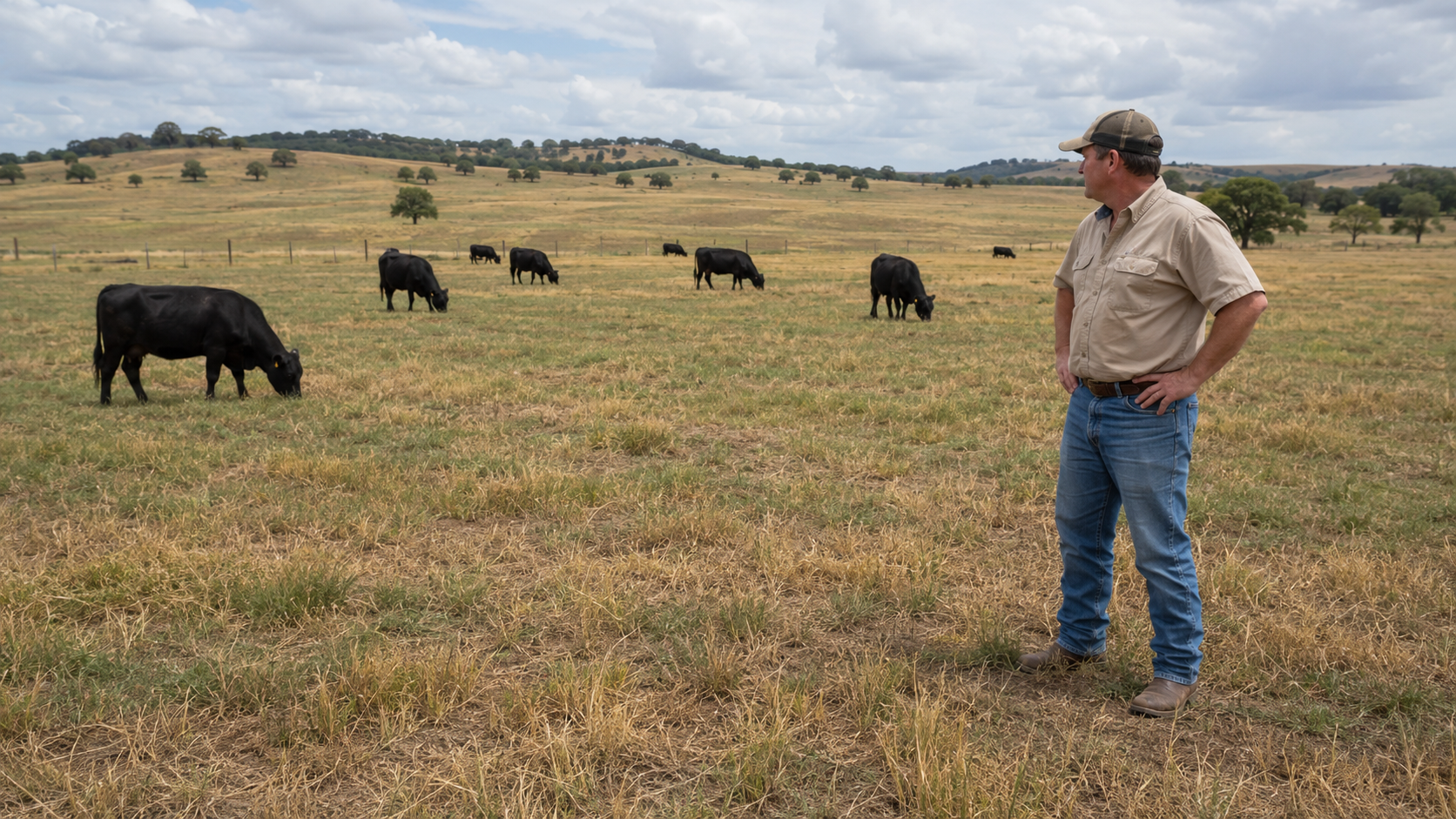
Drought Stocking Rate Calculator: How to Protect Your Cattle Herd Before Grass Shows Stress
A rancher in western Nebraska walked his pasture in early May 2026 and saw green grass. Not lush spring growth, but green. The cattle were grazing. Nothing looked alarming. He decided to hold his normal stocking rate through summer. By mid-July, that pasture was gone. Completely grazed down to dirt in the high-traffic areas. What little grass remained had no recovery capacity. He destocked in August, paying $200 per ton for hay to feed cattle that should have been sold in May. His pasture took three years to recover. The financial damage exceeded $40,000 when he calculated lost cattle sales, emergency feed costs, and pasture rehabilitation expenses.
The grass was green in May. But the soil moisture deficit had already started in March. By the time visible stress appeared in the grass, the drought had been progressing underground for 60 days. His decision to maintain normal stocking rates in May locked in the destruction that became visible in July.
Seventy-nine percent of the US beef cow herd sits in drought-affected areas as of spring 2026. Nebraska pasture condition was rated only 4 percent good in early May. These are not outlier situations. These are widespread structural conditions affecting cattle operations across major production regions. Understanding when and how to reduce stocking rates before grass shows severe stress is not optional knowledge. It is the difference between protecting your pasture capital and destroying productivity for years.
This article explains the soil moisture lag principle, provides a stocking rate calculation framework, details the signs that trigger destocking decisions, and shows you how to implement these strategies before drought costs you money.
Why Soil Moisture Deficits Appear Before Grass Shows Stress
Oklahoma State University livestock economist Derrell Peel has documented extensively that soil moisture deficits precede visible grass stress by 30 to 60 days in typical drought progressions. This lag exists because perennial grasses have evolved survival mechanisms that mask early stress.
When soil moisture begins declining, grass plants prioritize root preservation over top growth. Root systems pull moisture from deeper soil layers. Leaf growth slows but does not stop immediately. The plant is already stressed but the visible indicators lag behind the physiological reality. By the time grass shows obvious stress through color change, reduced growth, or thinning stands, the plant has been operating under deficit conditions for weeks.
This lag creates a management trap. Producers see green grass and assume conditions are adequate. They maintain normal stocking rates because visible forage appears sufficient. But below ground, the grass is already compromised. Root growth has slowed. Moisture reserves are depleted. The grass has lost its capacity to recover from grazing pressure.
When the visible stress finally appears, the grass is already severely damaged. High stocking rates during this period compound the problem. Cattle graze the stressed grass down to soil level in preferred areas. Without adequate moisture and without leaf area for photosynthesis, that grass cannot regrow. The pasture effectively dies in patches, creating bare ground that erodes and allows weed invasion.
The Nebraska pasture condition report from May 2026 illustrates this dynamic. Only 4 percent of pasture rated good condition. But cattle were still grazing those pastures because green forage remained visible. The poor condition rating reflected below-ground moisture deficits and reduced grass vigor that would not become visually obvious for another 30 to 45 days. Producers who maintained normal stocking in May were already overstocked relative to actual forage production capacity.
Weather patterns in 2026 have compounded this problem. Many regions experienced La Niña conditions through winter and early spring, delivering below-average precipitation. Snowpack in western states was significantly below normal, reducing spring runoff and soil moisture recharge. Regions that depend on March and April rainfall for pasture establishment saw limited precipitation, leaving soil moisture levels low as cattle turned out to grass.
This pattern is not unique to the United States. Drought affects cattle operations globally. Producers in Australia have faced prolonged drought conditions over the past decade, forcing widespread destocking and herd reduction. UK producers, particularly in Scotland and Wales, face variable rainfall and must manage grazing pressure carefully to maintain pasture productivity. The principles of early destocking apply universally regardless of geography.
The key insight from Peel's analysis is that waiting for visible grass stress before adjusting stocking rates guarantees that you are already overstocked relative to actual forage production. The decision to destock must be made based on soil moisture and precipitation patterns, not based on the current appearance of your grass.
The 70 Percent Forage Consumption Rule
Sustainable grazing management requires leaving adequate residual forage to maintain plant health and enable regrowth. The 70 percent rule provides a practical guideline. In normal conditions, cattle should consume no more than 70 percent of available forage during a grazing period. The remaining 30 percent stays on the plant, maintaining leaf area for photosynthesis and protecting growing points.
Under drought conditions, this rule becomes even more critical. Grass operating under moisture stress has reduced ability to regrow after grazing. Taking more than 70 percent of available forage during drought essentially kills the grass in many soil and climate conditions. The plant lacks the moisture and energy reserves to recover from severe defoliation.
Calculating 70 percent utilization requires estimating total forage production and tracking consumption. This is imprecise in practice but can be approximated through pasture monitoring. Walk your pastures weekly during drought periods. Measure grass height in multiple locations. Compare current height to baseline measurements from earlier in the season. If average grass height has declined by more than 50 percent and new growth is minimal, you are approaching or exceeding the 70 percent threshold.
Visual indicators supplement measurement. Look at the overall density of grass coverage. Are bare soil patches appearing in high-traffic areas? Are cattle spending more time searching for forage rather than grazing steadily? Are preferred grass species being grazed down to growing points while less palatable species remain? These patterns indicate overconsumption.
The challenge in drought is that forage production declines while cattle appetite remains constant. A pasture that normally produces 3,000 pounds of forage per acre may only produce 1,500 pounds during drought. But each cow still requires 25 to 30 pounds of dry matter daily. The stocking rate that was appropriate for normal forage production becomes twice the appropriate rate when production halves.
Most producers do not measure forage production precisely. But you can observe trends. If your pastures normally remain green and dense through mid-summer but this year they are showing stress in early June, production is down. If you normally do not need to rotate pastures until July but this year you are running out of grass by late May, production is down. These observations signal that your stocking rate exceeds production capacity.
The 70 percent rule also protects pasture recovery potential. Grass that retains adequate leaf area and growing points can respond quickly when moisture returns. Grass grazed to soil level may take months or years to recover even with adequate rainfall. The difference between 70 percent utilization and 90 percent utilization is not just current cattle performance. It is the recovery timeline and long-term productivity of your pasture resource.
Producers who maintain 70 percent utilization during drought years position their operations to restock quickly when conditions improve. Producers who overgraze their pastures during drought face multi-year recovery periods with reduced carrying capacity and increased weed pressure. The short-term cost of destocking is small compared to the long-term cost of pasture destruction.
Calculating Safe Stocking Rates Under Drought Conditions
Stocking rate calculation in normal years uses baseline carrying capacity adjusted for forage production. Under drought, you must adjust further for reduced production, extended recovery periods, and increased risk.
Start with your normal carrying capacity. A typical cow-calf pair requires 2 to 3 acres of productive pasture in moderate rainfall regions of the United States. Arid regions require 20 to 50 acres per pair. Your baseline depends on your soil type, grass species, and historical rainfall patterns.
Next, estimate current forage production as a percentage of normal. If rainfall is 50 percent of normal and your pastures show early stress, assume production is 50 to 60 percent of normal. If rainfall is 70 percent of normal and stress is minimal, assume 70 to 80 percent production. This is imprecise but provides a working estimate.
Multiply your normal carrying capacity by your estimated production percentage. If you normally stock 100 pairs on 300 acres and production is 60 percent of normal, your adjusted carrying capacity is 60 pairs. That is the maximum safe stocking rate. To build a safety margin, reduce by an additional 10 to 20 percent, bringing you to 50 to 55 pairs.
This calculation tells you how many cattle your pasture can support without exceeding 70 percent utilization. Compare this number to your current stocking rate. If you are overstocked, you must destock, purchase supplemental feed, or lease additional pasture.
The timing of this calculation matters. Conduct it early in the grazing season, ideally in late April or early May for summer grazing operations. Do not wait until June or July when grass stress is visible. By then, you have already overgrazed and the decision becomes about damage control rather than prevention.
Regional differences affect the calculation. Nebraska and the central plains face different drought dynamics than the southeast or Pacific northwest. But the principle is universal. Estimate production. Calculate capacity. Adjust stocking accordingly.
UK producers face similar calculations with region-specific variables. Scottish upland pastures under dry spring conditions may require stocking rate reductions of 30 to 40 percent below normal. Lowland pastures with better soil may tolerate smaller adjustments. Australian producers in Queensland or New South Wales routinely calculate stocking rates based on rainfall patterns and adjust quarterly as conditions evolve.
One common mistake is assuming short-term drought will end quickly. Spring drought often extends into summer. Producers who maintain high stocking rates in May hoping for June rain frequently face disaster when the rain does not arrive. The conservative approach is to destock early based on current conditions, not based on optimistic weather forecasts.
When to Destock and How Much to Remove
Specific triggers indicate that destocking is necessary. These triggers are based on measurable conditions, not subjective assessment.
Trigger One: Precipitation 60 Percent or Less Than Normal
If cumulative precipitation from January through April is 60 percent or less than normal for your region, destock by 20 to 30 percent before turnout. This applies even if grass currently looks adequate. The soil moisture deficit guarantees reduced production during the coming grazing season.
Trigger Two: Pasture Condition Score Below Fair
USDA classifies pasture conditions as excellent, good, fair, poor, or very poor. If your pastures rate below fair in spring, reduce stocking by 30 to 40 percent. Fair condition means grass is adequate but not optimal. Below fair means insufficient forage production capacity exists.
Trigger Three: Grass Height 50 Percent Below Normal for the Date
Measure grass height in late April or early May. Compare to historical norms for that date. If height is 50 percent below normal, reduce stocking by 25 to 35 percent. Grass that has not established adequate growth by early season will not catch up under continued dry conditions.
Trigger Four: Subsoil Moisture Deficit
Check subsoil moisture if you have access to moisture monitoring equipment or extension service data. If subsoil moisture is depleted below 50 percent of capacity, grass will stress rapidly even if topsoil appears adequate. Destock by 20 to 30 percent.
Trigger Five: Forecast Indicates Continued Dry Conditions
Long-range weather forecasts are imperfect but provide guidance. If forecasts indicate La Niña continuation, below-average precipitation, or above-average temperatures for the next 90 days, plan for reduced forage production and destock accordingly.
When multiple triggers apply simultaneously, adjust stocking rates more aggressively. Spring 2026 in Nebraska met Triggers One, Two, and Three concurrently. Producers facing that combination should have destocked by 40 to 50 percent or more to protect pasture capital.
The amount to destock depends on severity and your operation's flexibility. A 20 percent reduction means selling or moving 20 of 100 cows. A 40 percent reduction means 40 of 100. This is not subtle adjustment. Effective destocking requires removing significant numbers.
Which cattle to remove matters. Cull older cows first. Remove cows with marginal production history. Sell bred cows if markets support it rather than holding them through drought. Keep your most productive, youngest, highest-genetic-value animals and remove everything else. This protects your core breeding program while reducing grazing pressure.
Some operations can lease additional pasture rather than destock. If pasture lease costs less than the long-term damage from overgrazing your own land, leasing is economically rational. But many regions face widespread drought simultaneously, making additional pasture unavailable at any price.
Supplemental feeding is an alternative to destocking but rarely economical. Hay prices increase during drought as demand surges and supply tightens. Feeding hay to cattle on drought-stressed pastures accelerates pasture damage as cattle concentrate around feeding areas, creating heavy-use zones with no recovery potential. If you must feed, remove cattle from pasture entirely and drylot feed them.
The Long-Term Cost of Waiting Too Long
Producers who delay destocking face compounding costs that extend years beyond the drought event. These costs often exceed the immediate revenue loss from selling cattle.
Overgrazed pastures lose productive capacity for three to five years after severe drought. Bare ground erodes. Weed species invade. Desirable grass species die out. Reseeding costs $100 to $300 per acre depending on region and method. For a 500-acre operation, that equals $50,000 to $150,000 in rehabilitation expenses.
Reduced carrying capacity after pasture destruction means fewer cattle can be grazed even after moisture returns. An operation that normally runs 100 pairs may be limited to 60 to 70 pairs for several years during recovery. That lost production capacity equals $30,000 to $40,000 annually in foregone calf sales at current market prices.
Emergency feed costs during late-season destocking exceed early-season sale proceeds. Selling cows in May captures normal market pricing. Selling in August or September faces distressed market conditions as thousands of producers simultaneously destock, driving prices down. The difference can be $200 to $400 per cow.
Rebuilding herd numbers after drought requires purchasing replacement females at elevated prices. Bred cows average $4,000 in 2026. Rebuilding a herd reduced from 100 to 60 cows costs $160,000 before the operation returns to pre-drought production levels.
The total cost of late destocking frequently exceeds $100,000 for a 100-cow operation when pasture rehabilitation, lost production, distressed sales, and rebuilding costs are combined. Early destocking costs $20,000 to $30,000 in foregone calf sales that year but protects pasture capital and enables rapid restocking when conditions improve.
Producer age and financial capacity affect these calculations. Older producers approaching retirement may decide to liquidate entirely rather than endure drought and recovery. Younger producers with strong balance sheets may tolerate higher risk. But no producer benefits from destroying pasture capital through overgrazing during drought.
Practical Steps to Implement This Week
If your region faces drought conditions right now, here are the specific actions to take immediately.
First, obtain current precipitation data for your location. NOAA and regional climate centers provide detailed precipitation records. Compare year-to-date precipitation to historical averages. If you are below 70 percent of normal, drought conditions exist regardless of current grass appearance.
Second, conduct a pasture walk this week. Measure grass height in 10 to 15 representative locations across your operation. Record average height. Compare to your normal height for this date based on memory or photos from previous years. If height is significantly below normal, production will be reduced.
Third, count your cattle and calculate current stocking rate. Divide total animal units by total acres. Compare to your baseline stocking rate. If you are at or above baseline under drought conditions, you are overstocked.
Fourth, estimate forage production as a percentage of normal based on precipitation, pasture condition, and grass height data. Use this percentage to calculate adjusted carrying capacity. Determine the gap between current stocking and safe stocking.
Fifth, decide how to close that gap. Options include selling cattle, leasing pasture, or feeding supplemental hay. Evaluate costs and benefits of each option. In most cases, selling cattle early is the most economical choice.
Sixth, implement the plan within 30 days. Do not delay hoping for rain. If rain arrives and conditions improve, you can restock. If rain does not arrive, you have protected your pasture and avoided emergency destocking later at distressed prices.
Seventh, monitor conditions every two weeks throughout the summer. Drought can worsen rapidly. Be prepared to make additional adjustments if conditions deteriorate beyond initial projections.
Document your decision process and outcomes. Record precipitation, pasture condition, stocking rates, and financial results. This data will inform your decisions in future drought years and help you refine your drought management strategy over time.
The Bottom Line on Drought Destocking
Seventy-nine percent of US cattle sit in drought-affected regions in spring 2026. Nebraska pasture rated 4 percent good condition. These conditions will not resolve quickly. Producers must act now based on soil moisture and precipitation deficits, not based on current grass appearance.
The soil moisture lag principle is clear. By the time grass shows visible stress, you are already overstocked and the damage is done. Early destocking based on precipitation and pasture condition protects your pasture capital and positions your operation for rapid recovery when moisture returns.
The 70 percent forage consumption rule is not negotiable under drought. Exceeding that threshold kills grass and destroys productivity for years. Calculate your safe stocking rate based on current production estimates. Adjust your herd size to match.
The cost of early destocking is measured in thousands of dollars. The cost of late destocking is measured in tens of thousands or more when rehabilitation, lost production, and rebuilding expenses are included. The economics favor early action.
Producers who destock early maintain their pasture capital, capture better market prices, and restock faster when conditions improve. Producers who wait face years of recovery and substantial financial losses.
This is not a comfortable decision. Selling cattle that you intended to keep disrupts your operation and reduces current year revenue. But the alternative is worse. Destroying your pasture through overgrazing during drought creates problems that last far longer than the drought itself.
The trigger conditions described in this article are not theoretical. They are occurring right now across major cattle production regions. If your operation meets any of these triggers, implement destocking plans this month. Protect your pasture. Protect your long-term productivity. Make the decision based on data and calculation rather than optimism or tradition.
Drought is a biological and economic reality in cattle production. Managing it successfully requires acting before the crisis becomes visible. The tools and framework in this article give you the information needed to make those decisions with confidence. Use them.
The Cattle Calf delivers one email every Tuesday morning with the specific market intelligence and operational insights that experienced cattle producers use to make better decisions this week. Subscribe at cattlecalf.com