
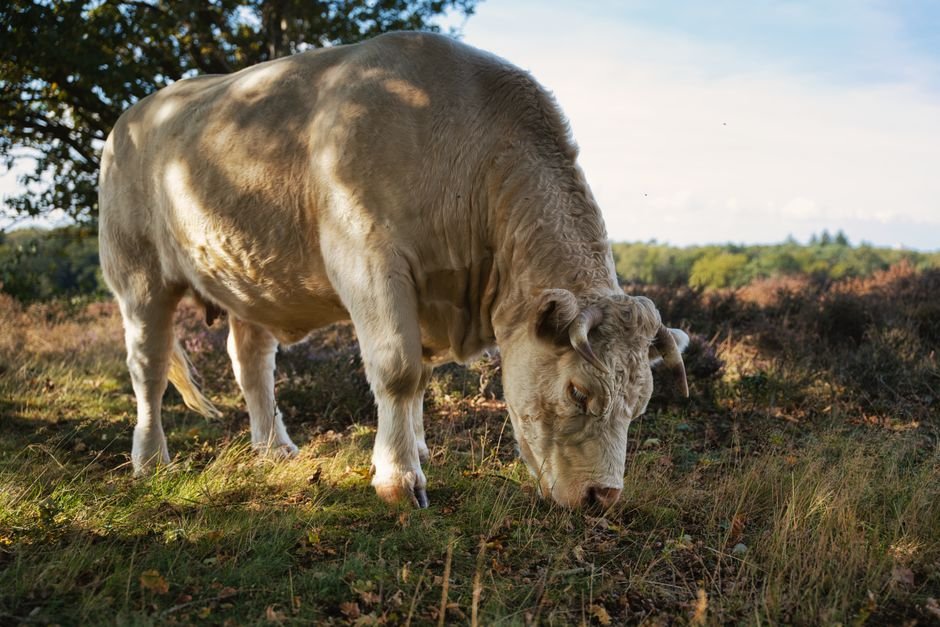
What Was the Aurochs?
The aurochs (Bos primigenius) was a large wild species of cattle that roamed Europe, Asia, and North Africa for thousands of years. Standing up to 6 feet (1.8 meters) tall at the shoulder and weighing as much as 1,500 kilograms, it was the direct wild ancestor of modern domestic cattle breeds. The aurochs had a robust build, long curved horns, and a dark coat with a characteristic light stripe down its back, traits distinct from today’s farmed cattle.
The aurochs was not only physically impressive but also ecologically significant. It was one of the largest terrestrial herbivores in its environment, often referred to as a “megaherbivore,” whose grazing habits shaped the vegetation structure across vast landscapes. Fossil records suggest that aurochs populations fluctuated in response to climatic changes during the Pleistocene, adapting to varying habitats from open grasslands to forest edges. The species’ name itself originates from the German word “Auerochs,” meaning “primeval ox,” reflecting its ancient presence and importance in human history.
Historical Range and Importance of the Aurochs
During the Pleistocene and Holocene epochs, the aurochs ranged widely across temperate and subtropical regions. Its habitat extended from Western Europe through the steppes of Central Asia to the Indian subcontinent. This vast distribution indicates its adaptability to a variety of climates and ecosystems, including forests, river valleys, and open plains.
Ecologically, the aurochs was a keystone species, playing a critical role in ancient ecosystems as a large herbivore. Its grazing helped maintain open habitats, which in turn supported a diversity of flora and fauna. By trampling and browsing, aurochs influenced seed dispersal and nutrient cycling, profoundly impacting the structure of plant communities. Aurochs herds also served as a key prey resource for large predators such as wolves (Canis lupus), cave lions (Panthera spelaea), and humans, thus anchoring complex food webs.
Humans hunted aurochs for millennia, which influenced their population dynamics and likely spurred early domestication efforts. Archaeological evidence, including bone remains and hunting tools, reveals that aurochs were a vital source of meat, hide, and bone for prehistoric peoples. The importance of the aurochs to early human societies is immortalized in cave paintings like those at Lascaux, Chauvet, and Altamira, where the aurochs is frequently portrayed with vivid detail, emphasizing its majestic stature and symbolic role in ritual and storytelling. For example, the Lascaux paintings, estimated to be over 17,000 years old, depict aurochs alongside other megafauna, highlighting their prominence in Paleolithic culture.
The Role of the Aurochs in Cattle Domestication
Modern cattle (Bos taurus and Bos indicus) descend directly from the aurochs. Genetic studies indicate that domestication occurred around 8,000 to 10,000 years ago in the Fertile Crescent and the Indus Valley, where humans selectively bred aurochs for traits like docility, milk production, and meat yield. These domestication events are among the earliest examples of animal husbandry, marking a pivotal shift in human civilization from nomadic hunter-gatherer lifestyles to settled agricultural societies.
Domestication dramatically changed the aurochs’ physical and behavioral traits. Compared to their wild ancestors, domestic cattle are generally smaller, with less aggressive temperaments and a wider variety of coat colors and horn shapes. This morphological diversity arose due to selective breeding practices tailored to human needs and environmental conditions. For instance, Bos indicus (zebu cattle) developed distinct humps and heat tolerance suited for arid regions, whereas Bos taurus (European cattle) exhibit a broader range of sizes and coat patterns.
Despite these changes, many primitive cattle breeds still retain physical and behavioral characteristics reminiscent of the aurochs. The Spanish fighting bull, with its muscular build and aggressive nature, and the Hungarian Grey cattle, known for its long, lyre-shaped horns and resilience, are examples of breeds that preserve ancestral traits. Additionally, breeds like the Scottish Highland cattle display thick coats and hardiness adapted to cold climates, reflecting the diversity inherited from aurochs populations spread across different environments.
Advancements in ancient DNA analysis have provided insight into the domestication process, revealing that multiple aurochs populations contributed genetically to modern cattle, implying a complex web of early human-animal interactions across Eurasia. These findings challenge earlier models that posited a single domestication event, showing instead a mosaic of domestication and introgression with wild populations over millennia.
What Happened to the Aurochs? Causes of Extinction
The extinction of the aurochs was a slow process driven by a combination of factors, primarily habitat loss, overhunting, and competition with domestic livestock. By the Middle Ages, human populations had expanded agricultural lands, drastically reducing the wild forests and grasslands that aurochs depended on. The gradual deforestation and conversion of natural habitats to farmland and pastures fragmented aurochs populations, reducing genetic diversity and making them more vulnerable to environmental stresses.
Extensive hunting pressure further diminished their numbers. The aurochs was prized as a game animal for nobility in medieval Europe, and hunting expeditions were often organized to capture or kill these formidable beasts. Historical records from Poland, for example, document royal hunting preserves specifically established to manage the remaining aurochs populations. Despite these protections, uncontrolled poaching and habitat encroachment continued.
For more on this, see our related guide: Proven Tips to Reduce Weaning Stress in Calves During Hot Weather.

The last recorded aurochs lived in the Jaktorów Forest near Warsaw, Poland, where the population was protected but ultimately unable to recover. The final known individual, a female, died in 1627. Her death marked the species’ extinction, although small, isolated populations likely disappeared earlier elsewhere. The extinction timeline is notable because it occurred in the early modern period, a time when naturalists and chroniclers began documenting wildlife systematically. This has left us with detailed accounts of the aurochs’ decline, unlike many prehistoric extinctions that remain obscure.
Unlike many other extinct large mammals, the aurochs’ disappearance is well-documented due to its relatively recent extinction and close relationship to domestic cattle. This has allowed scientists to reconstruct much of its biology and ecology with greater certainty. Moreover, the aurochs’ extinction serves as a cautionary example of the impacts of human expansion, habitat degradation, and overexploitation on large wild herbivores.
Physical and Behavioral Characteristics of the Aurochs
Adult aurochs were much larger than most modern cattle breeds. Bulls could reach a height of about 180 cm (6 feet) at the shoulder and weighed between 700 and 1,500 kilograms (1,500 to 3,300 pounds). Females were smaller but still robust. Their coloration was typically black or dark brown with a pale dorsal stripe, and their horns were long, curved, and pointed forward. Variations in coat color and size likely existed among geographic populations, with northern specimens tending to be larger and darker, while those from southern regions exhibited lighter hues.
Behaviorally, aurochs were likely more aggressive and nervous than domestic cattle, traits common in wild herbivores facing predation. Contemporary descriptions suggest they were highly alert, with strong herd instincts for protection. They lived in herds typically organized by females and their offspring, while mature bulls often roamed solitarily or formed small bachelor groups except during the mating season. Seasonal migrations were common, as herds moved between lowland wintering grounds and upland summer pastures to exploit changing vegetation availability.
The aurochs’ aggressive nature and size made them formidable opponents for predators and humans alike. Their long, forward-curving horns were used both in intraspecific combat and defense. They likely engaged in ritualized displays of dominance during the rut, including horn clashes and vocalizations. These behaviors are reflected in the aggressive temperament seen in some primitive cattle breeds that retain aurochs ancestry.
Physiologically, the aurochs was adapted for endurance and strength rather than speed, with a muscular neck and shoulders supporting its massive horns. Their digestive systems were efficient at processing coarse and fibrous plant material, enabling survival in nutrient-poor environments. Compared to modern cattle, the aurochs likely had higher metabolic rates associated with their wild lifestyle and greater need for mobility and vigilance.
Attempts to “Bring Back” the Aurochs: Breeding and Conservation Efforts
Since the aurochs’ extinction, several projects have aimed to recreate or approximate the aurochs through selective breeding. The most notable is the Heck cattle, developed in the 1920s and 1930s by German zoologists Heinz and Lutz Heck. They crossbred primitive European cattle breeds such as Hungarian Grey, Spanish fighting bulls, and Highland cattle to produce animals resembling the aurochs’ size and appearance. Although Heck cattle exhibit some physical similarities—such as horn shape and body size—they do not fully replicate the genetic makeup or ecological role of the aurochs.
Heck cattle have been used in various European rewilding initiatives, including the Oostvaardersplassen nature reserve in the Netherlands, where they contribute to habitat management by mimicking the grazing patterns of extinct megafauna. However, controversies have arisen regarding their welfare and ecological impact, as their behavior and adaptations are not identical to those of wild aurochs.
More recent efforts, like the Uruz Project in the Netherlands, aim to refine breeding programs by incorporating breeds like Sayaguesa, Maremmana, and Chianina cattle to more closely mimic the aurochs’ phenotype and ecological role. These projects use modern genetic tools and phenotypic selection to improve the resemblance of “breeding-back” cattle to the extinct aurochs, focusing on traits such as horn curvature, size, coloration, and hardiness.
Beyond breeding, conservationists and ecologists consider the reintroduction of aurochs-like cattle as a method to restore ecosystem functions lost after the aurochs’ extinction. Such initiatives are part of broader rewilding efforts intended to increase biodiversity, restore natural grazing regimes, and counteract the effects of habitat fragmentation and successional overgrowth. The success and ethics of these programs continue to be subjects of scientific research and public debate.
In addition to breeding-back efforts, advances in genetic engineering and ancient DNA technologies have sparked discussions about the theoretical possibility of “de-extinction.” While no intact aurochs genomes are currently available for cloning, researchers are exploring the potential to edit domestic cattle genomes to recreate aurochs-like traits. However, this remains speculative and faces significant technical, ethical, and ecological challenges.

If you’re also looking into this, our article on Can Cows Eat Watermelon? How to Safely Feed Cull Fruit to Your Herd covers it in more detail.
Ecological Legacy and Cultural Significance
The aurochs’ extinction changed European and Asian ecosystems by removing a large wild grazer that affected vegetation and predator-prey dynamics. Its disappearance arguably contributed to changes in forest composition, such as increased woody plant density and reduced grassland areas, which in turn affected other herbivores and predators. The loss of aurochs may have facilitated the dominance of domestic livestock, altering nutrient cycling and soil structure in agroecosystems throughout history.
In cultural terms, the aurochs left a lasting legacy across many civilizations. It appears in ancient art, mythology, and heraldry. For example, the aurochs is a national symbol in Poland, appearing on coats of arms, currency, and as an emblem of strength and persistence. The aurochs also features prominently in Baltic and Slavic folklore, often symbolizing wild nature and untamed power.
Throughout history, the aurochs has been revered and feared, inspiring stories and rituals tied to hunting and fertility. In medieval Europe, aurochs horns were sometimes used as ceremonial drinking vessels, and their images adorned royal seals and banners. Today, the aurochs serves as a focal point in the study of animal domestication and evolutionary biology, providing insights into how humans have shaped animal species and ecosystems over millennia.
Furthermore, the aurochs’ cultural prominence endures in literature and popular media, where it is often portrayed as a symbol of the wild past and lost wilderness. This symbolic value is a driving force behind conservation and rewilding projects aiming to reconnect modern landscapes with their ecological heritage.
Summary Table: Aurochs vs. Modern Domestic Cattle
| Attribute | Aurochs (Bos primigenius) | Modern Domestic Cattle |
|---|---|---|
| Average Shoulder Height | ~180 cm (6 feet) for bulls | 120-150 cm (varies by breed) |
| Weight | 700-1,500 kg (1,500-3,300 lbs) | 400-1,000 kg depending on breed |
| Coat Color | Dark brown/black with pale dorsal stripe | Varies widely: white, brown, black, spotted |
| Horn Shape | Long, curved forward | Varies widely, often smaller or bred off |
| Behavior | Wild, aggressive, migratory | Domesticated, docile |
| Geographic Range (Historic) | Europe, Asia, North Africa | Worldwide |
Frequently Asked Questions
1. Are there any living aurochs today?
No, the aurochs went extinct in 1627. While some cattle breeds like Heck cattle attempt to replicate their appearance, no living aurochs remain. These breeding programs produce animals that resemble aurochs in appearance but are genetically domestic cattle and lack the full behavioral and ecological traits of true wild aurochs.
2. Why did the aurochs go extinct when other wild species survived?
The aurochs’ extinction was caused by intense human hunting, habitat loss due to agriculture and deforestation, and competition with domestic cattle, factors which combined uniquely to extinguish the species. Unlike some other large mammals, the aurochs was particularly vulnerable to habitat fragmentation due to its large home range requirements. Additionally, its value as a game animal and resource heightened hunting pressure, while interbreeding and competition with domestic cattle further compromised its survival.
3. How are modern cattle genetically related to the aurochs?
Modern cattle are domesticated descendants of the aurochs. Genetic studies show that all domestic breeds derive from aurochs populations that lived around 8,000 to 10,000 years ago. Ancient DNA analyses have identified multiple domestication centers and evidence of gene flow from wild aurochs into domestic herds, highlighting a complex domestication process. Both Bos taurus (European cattle) and Bos indicus (zebu cattle) trace their origins back to distinct aurochs populations in different geographical regions.
4. What is the significance of the aurochs in cattle breeding today?
The aurochs’ genetic legacy shapes many primitive cattle breeds. Some conservationists use this knowledge to breed hardy, disease-resistant cattle that possess traits of their wild ancestor, such as robustness, adaptability, and natural resistance to parasites. Breeds with aurochs-like traits are often promoted in sustainable agriculture and conservation grazing schemes, which aim to reduce reliance on intensive farming methods while supporting biodiversity.
5. Could the aurochs be brought back through cloning or genetic engineering?
While theoretically possible, no viable aurochs DNA samples exist for cloning, as ancient DNA is often degraded and incomplete. Current projects focus on selective breeding to approximate the aurochs rather than resurrecting the species genetically. Advances in CRISPR and other gene-editing technologies may one day allow for more precise genetic reconstruction, but ethical, ecological, and technical challenges remain significant barriers to true de-extinction.